
Straight Answers · Shareable Links
Frequently Asked Questions (The Skeptic's Guide)
In the peptide space, people are right to be skeptical—almost every "educational" site online is a disguised vendor funnel, an affiliate code directory, or a collection of cherry-picked Certificates of Analysis. Here are direct, verifiable answers to the questions we get asked most often. Every question has a # link you can copy and share directly.
-20°C reserve vials.How do you pick which compounds go into the Evidence Library and which batches get tested? #
Short answer: By real-world usage, community nominations, and safety risk—never by vendor request or payment.
We select compounds and testing targets across two independent tracks:
- 1. How compounds are chosen for the Evidence Library (92 compounds live): We cover the peptides and related research compounds people actually search for, ask clinicians about, or encounter online—ranging from FDA-approved GLP-1 receptor agonists (like semaglutide and tirzepatide) and late-stage investigational drugs (like retatrutide, survodutide, and mazdutide) to widely discussed gray-market compounds (like BPC-157, TB-500, and Russian bioregulators). If a compound has zero human clinical trials, we include it specifically so readers can see a clear No human data verdict instead of marketing hype.
- 2. How retail batches are chosen for blind laboratory testing: Once our Phase 1 intake and cold-storage station is funded and active, batch selection is driven by public safety risk (starting with high-demand injectable compounds where mislabeling, under-dosing, or endotoxin contamination poses the highest harm), community nomination votes, and unannounced random sampling across retail vendors. Vendors cannot nominate their own batches, cannot supply samples, and cannot pay to be tested or skipped.
Is the Open Peptide Project a stealth vendor front, affiliate funnel, or lead-generation site? #
Short answer: No.
We do not sell, compound, distribute, or broker peptides or research chemicals. You will never find an affiliate link, coupon code, "trusted vendor" ranking, or referral link anywhere on openpeptideproject.org. Our entire governance and conflict-of-interest structure is published in our Full Disclosure.
Doesn't one of the co-founders' family members own a peptide company? #
Short answer: Yes, and we disclose it up front rather than hiding it.
As detailed in our Conflict-of-Interest Disclosure, Caleb Greene (who contributed initial technical setup and owns a separate retail peptide business, Peptide Hall) is barred from serving as an incorporator or voting board member, barred from editorial or protocol decisions, barred from knowing which batches are queued for blind purchase, and permanently barred from sponsoring or advertising on the Open Peptide Project. Any Peptide Hall product tested by the project is bought blind at retail under the exact same unannounced protocol and published pass or fail.
How do we know vendors aren't sending you hand-picked 'golden vials' to pass lab testing? #
Short answer: We reject 100% of vendor-supplied samples.
Under our Sample Chain of Custody & Testing Standard, every tested batch is purchased anonymously at retail using non-project residential shipping addresses and standard consumer payment methods. Each order buys at least two sealed vials from the same lot: Vial A is relabeled with a blind alphanumeric code and shipped to an independent ISO/IEC 17025 accredited laboratory for RP-HPLC purity, LC-MS identity, net peptide content, and USP <85> endotoxin testing, while Vial B is locked in our continuously logged -20°C archival freezer for dispute verification.
How is the sample chain of custody documented from retail purchase to the lab? #
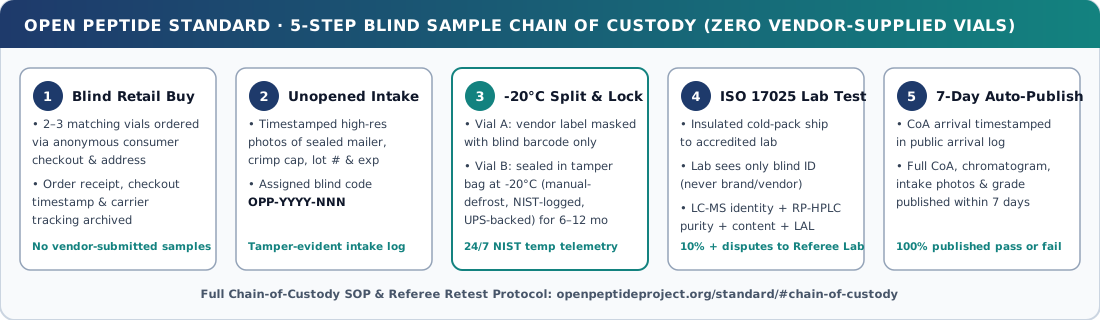
Short answer: Every batch follows a documented 5-step, two-vial chain of custody (read the full Chain of Custody protocol).
- Step 1 — Anonymous retail checkout: An independent purchaser buys at least two matching vials from the same lot using standard consumer payment and residential delivery addresses (never vendor-supplied).
- Step 2 — Photographic intake log: Unopened shipping packaging, crimp seals, cap colors, and lot numbers of both vials are photographed and assigned an internal chain-of-custody ID.
- Step 3 — Blind coding & lab shipment (
Vial A): Vendor labels onVial Aare replaced with a blind alphanumeric code so the ISO/IEC 17025 laboratory does not know the brand or source. - Step 4 —
-20°Carchival retention (Vial B): The matching unopened reserve vial (Vial B) is tamper-sealed and stored in our dedicated manual-defrost-20°Carchival freezer (monitored by a NIST-traceable temperature logger with LiFePO4 UPS battery backup, detailed under Phase 1 Cold Storage) so any disputed result can be re-tested at an independent referee lab. - Step 5 — Public CoA + chromatogram release within 7 days: Raw HPLC/LC-MS chromatograms, intake photos, and the full lab report are published permanently within 7 days of lab receipt, pass or fail.
Download the 1-Page Sample Chain-of-Custody & Cold-Storage SOP (SOP-COC-1.1, PDF) →
Will Canadian-sold peptides and international batches be included? #
Short answer: Yes—Canadian and international batches are in scope across the Evidence Library, the Observational Registry, and our blind retail testing roadmap.
- Evidence Library & Observational Registry (live / international): Our 92-compound Evidence Library is compound-based rather than US-only, and once our independent IRB exemption determination is complete, eligible adults (18+) in Canada and internationally can enroll in the Observational Registry and log lot numbers from Canadian or international vials.
- Phase 1 Blind Testing (US-delivered orders, including Canadian vendors that ship to the US): Any Canadian or international vendor whose public storefront ships retail orders to US residential addresses can be purchased blind and logged into our US
-20°Cintake and archival station right away under our 5-step Sample Chain of Custody. - Phase 2 Regional Blind Intake (Canada-only & international domestic vendors): Because shipping research vials across international borders can trigger customs holds or temperature spikes that break chain of custody, batches from domestic-only Canadian (or UK/EU/AU) vendors are purchased in-country by a regional blind shopper and routed directly to an ISO/IEC 17025 accredited laboratory (while logging the checkout region—e.g.,
US Retailvs.CA Retail—on the published batch report).
Can a sponsor or underwriter pay to bury a failing lab test or influence a library rating? #
Short answer: Never.
All blind batch underwriting goes into a pooled testing fund (see our 5-step blind underwriting workflow). Sponsors cannot pick which lot is purchased, cannot preview results before publication, and cannot block or delay a failing grade. Every completed laboratory Certificate of Analysis and raw chromatogram is published within 7 calendar days—whether it grades A+, Pass, Caution, or Fail.
Why aren't batch test reports live on the Test Results page yet? #
Short answer: Because proper chain of custody requires cold archival storage before the first vial is opened.
Rather than publishing unverified or vendor-supplied COAs to look busy on launch day, we published our complete Sample Chain of Custody & Testing Standard and Phase 1 prerequisite first: equipping our intake station with a dedicated manual-defrost -20°C archival freezer, a continuous NIST-traceable temperature logger, and LiFePO4 UPS battery backup so every retained reserve vial (Vial B) has defensible chain of custody from day one.
Are you promoting unproven peptides or treating rodent studies like human proof? #
Short answer: No—the exact opposite.
Every compound in our Evidence Library is graded strictly on published human clinical evidence (Strong, Moderate, Limited, Very limited, or No human data). Dozens of heavily hyped compounds carry a blunt No human data badge on our site because rodent or cell-culture papers do not prove human safety or efficacy. We never provide medical, dosing, reconstitution, or sourcing advice.
Are you already a 501(c)(3) nonprofit, and is the Observational Registry enrolling participants right now? #
Short answer: Not yet—and we state both openly on every governance page.
We put the public Evidence Library and Testing Standard live while completing formal nonprofit incorporation (with non-conflicted incorporators) and IRS 501(c)(3) filing. Likewise, our Observational Registry Protocol (v1.1) is published for public and scientific review, and participant enrollment remains closed until our independent commercial IRB exemption determination is complete.
Do you allow vendor sourcing, marketplace links, or Prohibited Transactions (Reddit Rule 7 policy)? #
Short answer: Strictly no.
The Open Peptide Project is a non-commercial scientific evidence library, analytical testing standard, and observational registry. We strictly prohibit buying, selling, sourcing, vendor URLs, discount codes, or personal medical and dosing advice across our website and all community channels, in full compliance with platform rules against prohibited transactions.